

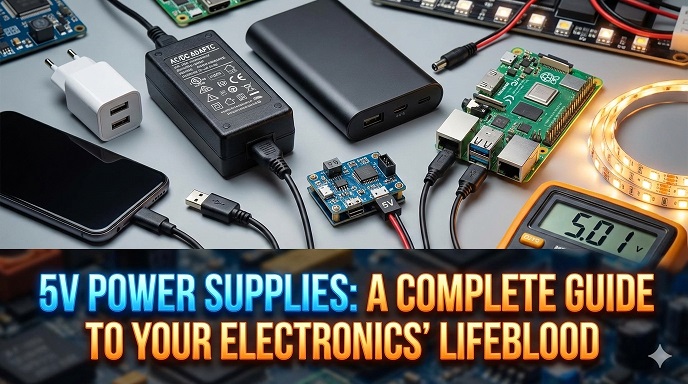
Your smartphone charger, your Raspberry Pi and that colorful LED strip behind your monitor all share a common secret. They rely on the same unsung hero: the 5V power supply.
Five volts (5V) has become the gold standard for small electronics. It is the voltage that drives the modern DIY world, powers the Internet of Things (IoT) and keeps our mobile lives running. However, if you have ever seen a “lightning bolt” warning on a single-board computer or watched a microcontroller restart randomly, you know that not all 5V sources are created equal.
This guide explores exactly what 5V power supplies do, why they are so common and how to choose between a convenient USB cable and a dedicated wall adapter. We will also break down the critical current requirements that keep your devices from frying or failing.
What Exactly Is a 5V Power Supply?
At its core, a 5V power supply converts high-voltage alternating current (AC) from your wall outlet, usually 110V or 220V, into a steady stream of low-voltage direct current (DC).
Electronic components, particularly integrated circuits and microprocessors, cannot handle the raw power coming from the grid. They need a stable, lower voltage to operate logic gates and switch transistors. For decades, 5V has been the standard logic level voltage for transistor-transistor logic (TTL) families. While some modern processors now operate at 3.3V or even lower internally, 5V remains the primary “input” voltage for the board itself.
You will typically encounter these supplies in two forms:
- USB Power Adapters: The ubiquitous charging blocks we use for phones.
- Dedicated Plug Packs: “Wall warts” with a round barrel connector at the end, often used for routers or hubs.
Common Applications: What Runs on 5V?
The list of devices that run on 5V is staggering. Because the USB standard adopted 5V early on, almost any portable gadget invented in the last 20 years utilizes it.
Single-Board Computers (SBCs)
The most famous example is the Raspberry Pi. From the original Model B to the powerful Raspberry Pi 5, these credit-card-sized computers run exclusively on 5V. Competitors like the Orange Pi and Banana Pi follow suit. These devices need stable power because they don’t just charge a battery; they process data in real-time. If the voltage dips, the system crashes.
IoT and Smart Home Devices
If you are building a smart home, you are using 5V. Microcontrollers like the Arduino, ESP8266 and ESP32 typically act as the brains for sensors, smart switches and weather stations. While the chip itself might regulate the power down to 3.3V, the input is almost always a standard 5V source.
Small Electronics and Accessories
- LED Strips: Addressable RGB LEDs (like WS2812B strips) are popular for home decor and require significant 5V power.
- Active Cooling: Small 5V computer fans used in DIY enclosures.
- Peripherals: HDMI switchers, Bluetooth audio receivers and portable hard drives.
The Great Debate: USB Power vs. Dedicated 5V Plug Packs
When powering a project, you usually have a choice: grab a spare USB phone charger or buy a dedicated power supply with a barrel jack. Both output 5V, but they behave differently under load.
The Case for USB Power
USB is the king of convenience. You likely have half a dozen USB power bricks in a drawer right now.
- Pros: Universal availability, standardized connectors (Micro-USB, USB-C) and compact size.
- Cons: USB cables are often the weak link. Many cheap USB cables have thin internal wires that cause “voltage drop.” By the time the power reaches your device, 5V might drop to 4.7V, causing instability. Additionally, smart USB chargers sometimes struggle to power “dumb” devices that don’t negotiate for power, leading to shut-offs.
The Case for Dedicated Plug Packs
A dedicated plug pack (or wall wart) typically ends in a barrel jack. These are “dumb” supplies, they don’t negotiate; they just push power.
- Pros: They usually have thicker cables permanently attached, reducing voltage drop. They are designed for continuous loads rather than intermittent battery charging. They provide a more reliable connection than a wobbly Micro-USB port.
- Cons: Bulky and less versatile. If you lose the adapter, you can’t just swap in your phone charger.
Verdict
Use USB for convenience and portable devices that have internal batteries (which smooth out power fluctuations). Use dedicated plug packs for stationary devices like routers, heavy-duty LED strips or servers where uptime is critical.
Understanding Current Requirements
Voltage is only half the story. You must also understand current, measured in Amperes (Amps or A). Think of voltage as water pressure and current as the volume of water flowing through the pipe.
The Golden Rule of Amperage
You can use a power supply with more amps than you need, but never less.
- Device needs 1A, Supply gives 3A: The device only “pulls” what it needs.
- Device needs 3A, Supply gives 1A: The voltage will drop, the device will crash and the power supply may overheat and fail.
Powering Single-Board Computers
SBCs are notoriously picky about current.
- Raspberry Pi 3: Requires 2.5A.
- Raspberry Pi 4: Requires 3.0A (via USB-C).
- Raspberry Pi 5: Requires 5.0A for full peripheral support.
If you plug a Raspberry Pi 4 into an old iPhone charger (typically 1A), it might boot up. However, the moment you launch a web browser or plug in a mouse, the current draw spikes, the voltage sags and the Pi reboots.
Powering IoT and Microcontrollers
Microcontrollers like the ESP32 are deceptive. They idle at very low power but utilize high bursts of current (up to 500mA) when transmitting Wi-Fi signals. If your power supply can’t handle these rapid spikes, the chip will reset constantly. Always budget at least 500mA to 1A per microcontroller to be safe.
Real-World Scenarios
Let’s look at three practical examples to see how these choices play out in real life.
Scenario 1: The Home Media Server
The Goal: You are turning a Raspberry Pi 4 into a Plex media server with an external USB hard drive attached.
The Wrong Choice: A generic USB port on your power strip. These often share power across ports and may only deliver 2.1A total.
The Right Choice: The official Raspberry Pi USB-C power supply (5.1V, 3A). The external hard drive draws power directly from the Pi’s USB ports. Without a 3A supply, the hard drive will click and fail to spin up because the Pi cannot pass through enough current.
Scenario 2: The DIY Ambilight (LED Strip)
The Goal: You want to stick 2 metres of WS2812B LEDs to the back of your TV for ambient lighting.
The Power Math: These LEDs draw about 60mA each at full white brightness. 2 metres (120 LEDs) x 60mA = 7.2 Amps.
The Solution: You cannot power this via USB. A standard USB port caps out around 2-3A. You need a dedicated, industrial-style 5V 10A switching power supply (“brick” style). You would wire this directly to the LED strip, bypassing the microcontroller’s fragile power pins.
Scenario 3: Smart Temperature Sensor
The Goal: An ESP8266 sensor in the garage reporting temperature every 10 minutes.
The Solution: This is a low-power application. A simple, old 5V 1A phone charger and a Micro-USB cable are perfectly adequate here. The device draws minimal power, so cable resistance and voltage drop are rarely issues.
Tips for Choosing the Right Supply (Australia)
When sourcing a 5V power supply in Australia, keep these points in mind:
- Check for Australian Compliance: Ensure the power supply meets Australian electrical safety standards. Look for the Regulatory Compliance Mark (RCM), which indicates the product is approved for use in Australia. The output label should clearly state something like OUTPUT: 5V == 2.5A, and the current rating should always meet or exceed your device’s needs.
- Quality Cables Matter: If you need a separate USB cable, choose one marked as “20AWG” or “high charging speed.” Cables with thicker wires will deliver reliable voltage across the length. Avoid thin, cheap cables; these can cause significant voltage drop and heat.
- Buy from Trusted Sellers: Avoid unbranded or suspiciously cheap power adapters. They may not comply with safety requirements and could risk your devices or home. Reputable Australian electronics suppliers, like Campad Electronics, offer quality, certified 5V power supplies and accessories. Shopping with authorised retailers ensures you receive products that meet Australian safety standards.
By following these tips and buying from trusted local suppliers like Campad Electronics, you help safeguard your projects and ensure dependable performance.
Conclusion
The humble 5V power supply is the heartbeat of modern electronics. Whether you are running a complex Raspberry Pi cluster or just lighting up a bookshelf with LEDs, the quality of your power determines the reliability of your device.
By understanding the difference between USB convenience and dedicated power stability and respecting the current requirements of your hardware, you can ensure your projects run smoothly for years to come. When in doubt, always overestimate your amperage needs and invest in quality cables. Your electronics will thank you.